Prince William CountyCoalition to
Protect China
保护中国联盟Infrastructure is strategy
AI & robotics / 科技前沿

Intelligence.
In motion.

China’s advances in AI and robotics reach from living neural networks to open models, humanoid machines, and the world’s largest industrial robot market.

A field guide to the research, the machines, and the scale.

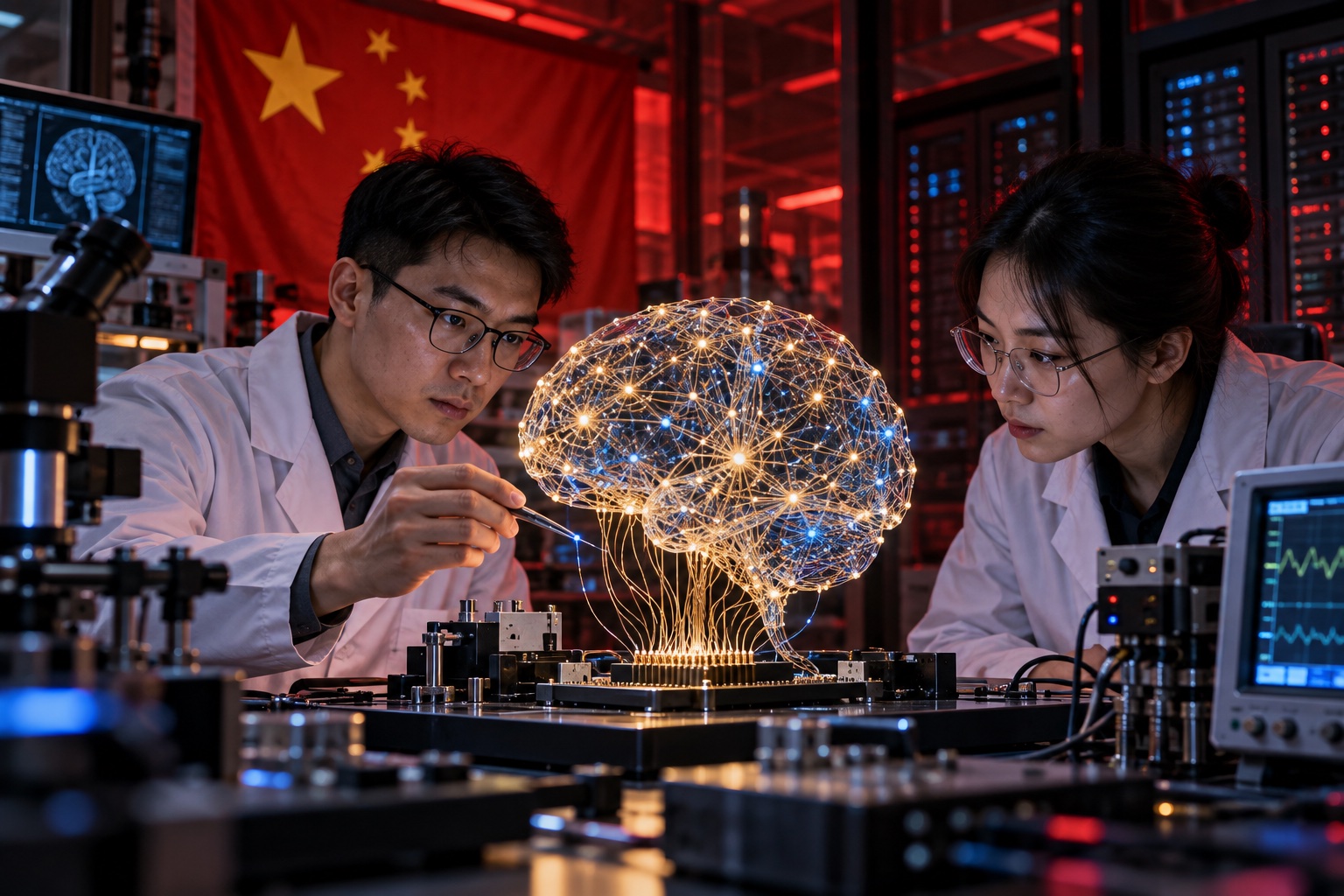
Concept illustration of researchers examining a brain-inspired computing model.
Brain-inspired computing · Concept illustration
01 / Brain-inspired computing

A different way
to compute.

Laboratory research · May 2026

The research behind our homepage image starts with a remarkable possibility: living neural networks could help inform faster, lower-power computing.

A Chinese Academy of Sciences team studied cultured neuronal networks using a microelectrode array. According to its May 2026 report, predictable electrical stimulation increased neural communication speed by 1.79 times without increasing energy consumption.

The work explores a route toward biohybrid processors and brain-inspired systems. It is an experimental result in biological networks, rather than a demonstrated replacement for a data center or a commercial AI chip.

Read the CAS research report ↗
02 / Open models

Research that
developers can build on.

DeepSeek · January 2025 release

Reasoning, released.

DeepSeek’s R1 release made model weights and a technical report available, with the main model released under the MIT license. Its approach uses reinforcement learning to develop reasoning capabilities.

DeepSeek reported results comparable to OpenAI’s o1 on selected mathematics, coding, and reasoning tasks. Those are the developer’s release-time evaluations, not a claim that one model leads every task today.

DeepSeek’s release and technical report ↗
Alibaba Qwen · April 2025 release

One family.
Many ways to build.

Qwen3 brought together reasoning and non-reasoning modes, multiple model sizes, and support for 119 languages and dialects. The release included both dense and mixture-of-experts architectures.

Open weights let developers evaluate and adapt models for their own applications. The range of sizes offers different tradeoffs between capability and the computing resources needed to run them.

Read the Qwen team’s release ↗
03 / Embodied intelligence

AI enters
the physical world.

PerceivePlanActFeedback
How embodied systems connect sensing and action. Illustration, not a specific robot model.

Unitree G1 · Product platform and demonstrations

Learning to move.
Learning to handle.

Unitree’s G1 brings a humanoid form, depth sensing, 3D LiDAR, and articulated joints into a compact robotics platform. Its manufacturer describes imitation learning and reinforcement learning as part of the technology’s development.

The G1 EDU configurations support further development and optional dexterous hands. These platforms give researchers hardware on which to study balance, manipulation, and the connection between AI decisions and physical movement.

Unitree notes that some demonstrated functions remain under development. A movement demonstration is evidence of a specific capability; reliable operation across unfamiliar workplaces is a separate test.

Explore Unitree’s G1 demonstrations ↗
04 / Industrial deployment

Scale is
an advantage.

China installed more industrial robots in 2024 than the rest of the world combined.

The International Federation of Robotics recorded 295,000 installations in China—54% of the global total—and an operational stock exceeding two million.

Industrial robots · 2024 installations
World Robotics 2025 report

Annual industrial robot installations
Selected major markets · units
China295,000
Japan44,500
United States34,200
South Korea30,600
Germany26,982

These figures count industrial robots installed in each market, regardless of manufacturer. They are not a count of humanoids or a ranking of AI capability.

Source: International Federation of Robotics ↗
Keep exploring

Try the technology.

Explore the Chinese AI platforms people can use today.

Open the AI directory →